
Going green – recycling of disposable insulin pens
In the NHS around 25% of carbon emissions are from medicines - disposable insulin pens have previously played a part in this, with millions being sent to landfill. However there are now two schemes available in the UK to recycle disposable pens - our Lead Palliative Care Pharmacist Karen Higlett covers which pens can be recycled and how it works.
Background
In the NHS around 25% of carbon emissions are from medicines with the majority of these coming from the manufacture, procurement, transport and use of medicines (20%) with the remaining 5% specifically from inhalers (3%) and anaesthetic gases (2%).
Ways of improving sustainability include:
- Improving prescribing and medicines use (sustainable prescribing, inhaler choice, anaesthetic gases and optimising medicines use)
- Tackling medicines waste (increasing awareness of the prudent use and disposal of medicines, research into the re-use of medicines and reducing the use of single use plastics)
- Preventing ill health (supporting people to stay well and so reduce the need for medicines)
- Infrastructure and ways of working (e.g. reducing travel)
Ref: Royal Pharmaceutical Society Sustainability Policies (First Published:21 October 2021).
Disposable insulin pens contain single use plastic and other items that can be recycled.
There are currently two schemes running in the UK at the present time which allow disposable insulin pens to be recycled: PenCycle by Novo Nordisk and RePen by Sanofi.
PenCycle
Novo Nordisk evidence suggests that in 2020, 23 million empty insulin pens (FlexPen and FlexTouch pre-filled devices) were either incinerated or sent to landfill as there was no viable recycling alternative. This prompted them to introduce the PenCycle scheme to reduce waste and help the NHS achieve critical environmental targets. Ref: Novo Nordisk (2021) UKMedInfo/PC/2023/001.
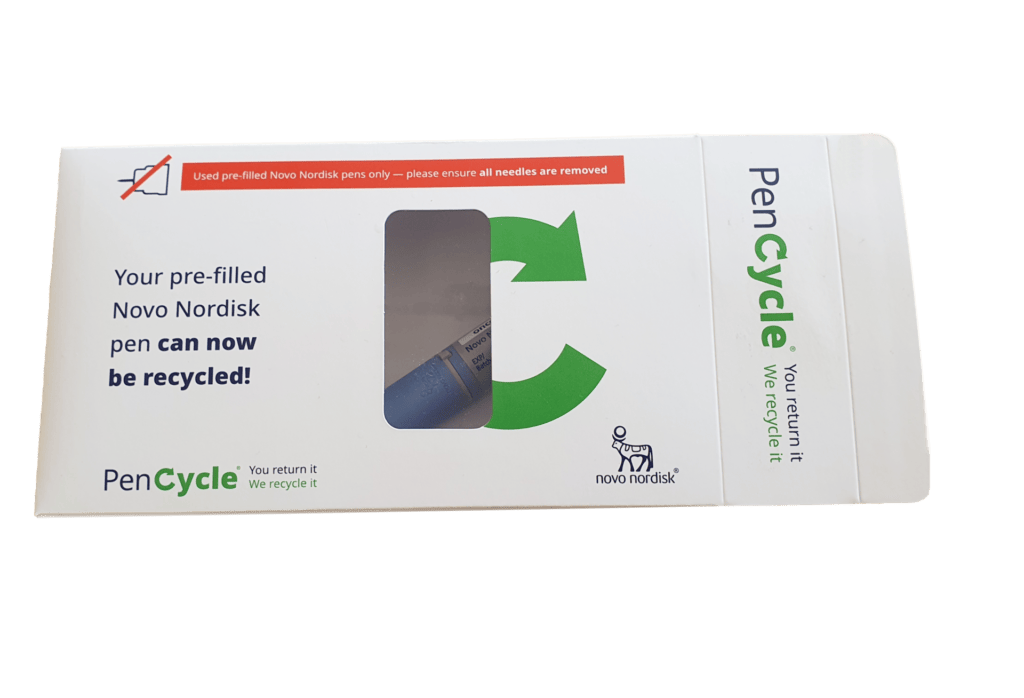
PenCycle is a nationwide initiative throughout the UK. PenCycle boxes can be obtained from participating pharmacies who can be found by searching by postcode on the PenCycle website, here.
Healthcare professionals can access materials, including return boxes and introductory leaflets, by contacting Novo Nordisk at diabetessupportteam@novonordisk.com
Which pens can be recycled via PenCycle?
Only Novo Nordisk disposable insulin pens (FlexPen and FlexTouch) and Ozempic pens.
What happens to the returned pens via PenCycle?
Empty, pre-filled Novo Nordisk pens returned via the PenCycle scheme are sent to a specialist facility in Denmark to be recycled using existing logistics routes to minimise environmental impact. Recycled plastic from these pens has gone into new furniture and the glass has been repurposed into lamps.
RePen recycling scheme (Sanofi)
RePen is a pilot programme run by the manufacturers, Sanofi, to recycle their used disposable insulin pens. The recycling packs can be ordered on the RePen website by patients or healthcare professionals.
Delivered as a flat A4 cardboard envelope containing a “post back” label to affix over the original address label. The packs can be ordered on the RePen website.

Healthcare professionals can order up to 3 return envelopes in one go. The cardboard envelope can hold up to 12 of the reusable pens for recycling. Needles must be removed before adding to the recycling envelope but the plastic cap can be recycled too.
Every envelope is returned to a UK based recycling site in the UK where the pens are first broken down and segregated into their constituent parts:
- Glass will be reutilised in glass manufacturing. This material can be recycled, infinitely.
- Metal will be melted, purified, then solidified. The metal element will be mixed with metals of the same grade to be traded and reutilised.
- Plastics will be used in the manufacture of Stormboard in the UK, turning waste plastic into weatherproof and recyclable furniture. At the end of life of this product, it can simply be recycled into a new Stormboard.
Disposable insulin pens that can be recycled using this scheme:
Toujeo® SoloStar®, and DoubleStar, Lantus® SoloStar®, Trurapi® SoloStar®, Admelog® SoloStar®, Apidra® SoloStar®, Suliqua® SoloStar®.
Recent Insights